notes from liguria, italy
The smell that takes us back
By Margherita Patrone - Sept 25, 2026 - 4 min read - Issue #13
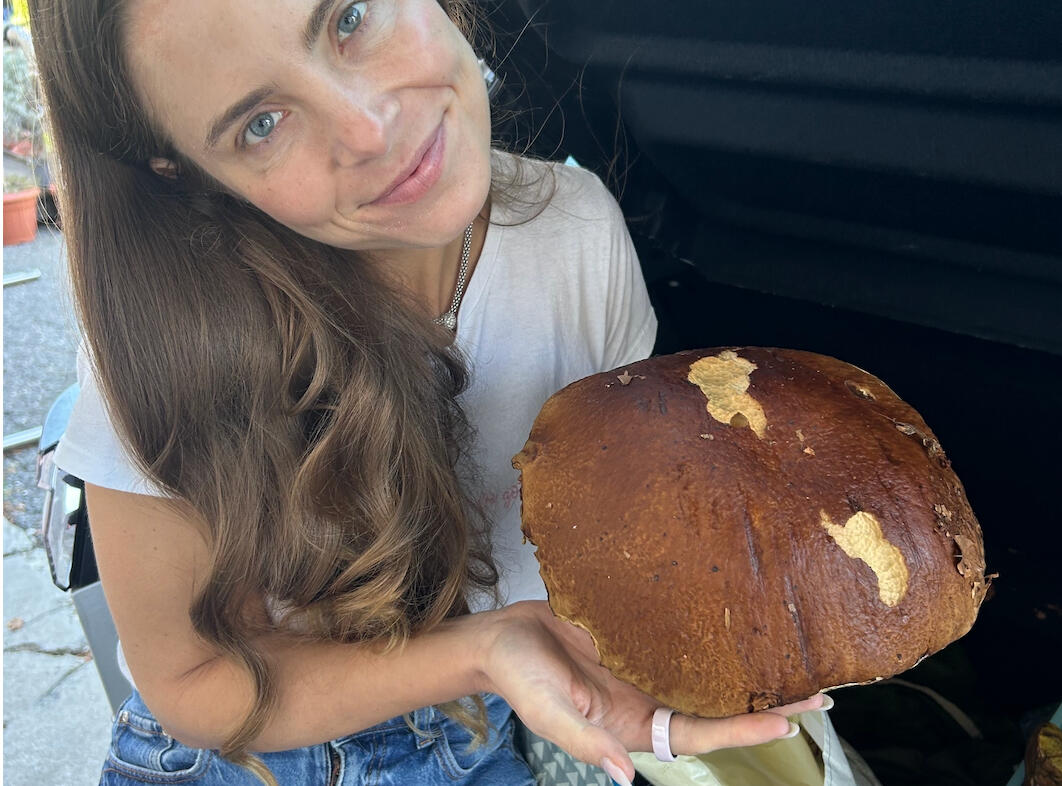
Last weekend, I went with Ettore, my fiancé, and his family to a tiny village in Tuscany called Castiglione del Terziere.
I'm not going to tell you how beautiful it is.
That deserves another newsletter.
I want to tell you what happened when we got out of the car.
Almost immediately, Ettore started smiling.
“The smell is exactly the same.”
He had spent time there as a child, running around with friends, disappearing into nature, playing outside for hours.
Pure freedom.
And standing there again, decades later, he wasn't simply remembering those days.
He seemed to feel them.
The happiness. The freedom. The familiarity.
Then he turned to me and said:
“It's like Proust's madeleine.”
And I knew exactly what he meant.
Because, strangely enough, I had been fascinated by this phenomenon long before I knew anything about behavioural science.
My grandmother's apple cake
When I was 18, finishing high school in Italy, I had to prepare a tesina for my final exams.
I chose olfactory memory.
The reason was my grandmother.
I loved her deeply, and she had Alzheimer's.
As her memory deteriorated, there were moments when people, places and events that should have been familiar no longer seemed to be.
But I noticed something.
Whenever her favourite apple cake was baking, she changed.
I can still picture it.
Her body relaxed.
Her expression softened.
There was a familiarity that hadn't been there moments before.
For a little while, she seemed to feel at home again.
I couldn't know precisely what she remembered.
But something about that smell appeared capable of reaching her when consciously trying to remember could not.
At 18, I wanted to understand why.
And last weekend, watching Ettore standing in that Tuscan village, I thought about it all over again.
The Proust effect
There is actually a name for what Ettore was experiencing.
The Proust effect.
In Marcel Proust's In Search of Lost Time, the narrator tastes a madeleine dipped in tea.
The sensation unexpectedly unlocks memories of his childhood in Combray.
What is fascinating is that the memory isn't deliberately searched for.
It arrives.
Researchers now study something similar under the term odour-evoked autobiographical memory: personal memories that are spontaneously retrieved when we encounter a particular smell.
And smell has an interesting relationship with memory.
Olfactory information is closely connected with brain regions involved in emotion and memory, including the amygdala and hippocampal system.
This helps explain something particularly interesting about smell-triggered memories:
they can feel intensely emotional.
A photograph might make you think:
I remember being there.
A familiar smell can sometimes produce something closer to:
I am there again.
Not literally, of course.
Memory is reconstructive, not a recording.
But emotionally, the distinction can feel surprisingly small.
Memory is context-dependent
And this connects to a broader idea in behavioural science: context-dependent memory.
Our memories don't exist independently of the circumstances in which they were formed.
The environment can become part of the retrieval mechanism.
A sound.
A place.
A taste.
A smell.
Encountering part of the original context can make associated information easier to retrieve.
Which means we may be surrounded by retrieval cues without even realising it.
The smell Ettore noticed wasn't meaningful in itself.
It had become meaningful because, years earlier, his brain had associated it with friends, nature, freedom and childhood.
One sensory cue opened the door to an entire network of associations.
Why smell feels different
There is another beautiful thing about olfactory memory.
Smell is difficult to describe.
Try describing the smell of your childhood home without saying what produced it.
It's surprisingly hard.
We have an enormous vocabulary for what we see.
Our vocabulary for smell is much poorer.
And yet a scent we struggle to describe in words can instantly feel familiar.
We can recognise something before we can explain why we recognise it.
That fascinates me.
Because we like to imagine memory as something conscious.
We decide to remember.
We search.
We retrieve.
But sometimes our environment gets there first.
A scent reaches us and, before we've consciously worked out what it is, something inside us has already responded.
The smells we are collecting today
And that made me think about something else.
What smells are we attaching to our lives right now?
The perfume of someone you love.
Coffee in your parents' kitchen.
Sunscreen on holiday.
Tomato sauce cooking on Sunday.
Freshly washed sheets.
Wet earth after rain.
A baby's skin.
Wood burning in winter.
We aren't deliberately filing these things away.
We aren't thinking:
This smell will remind me of this period of my life in twenty years.
But perhaps some of them will.
And one day, completely unexpectedly, we will encounter one again.
For a second, the present will disappear.
And somewhere we thought we had left behind will feel incredibly close.
The experiment
So this week's experiment is very simple.
Notice what your life smells like.
Choose one ordinary moment this week and consciously pay attention to its scent.
Your morning coffee.
Your partner's perfume.
Your kitchen while dinner is cooking.
The air outside your home.
Don't try to make it special.
Just notice it.
And then do the reverse.
The next time a smell unexpectedly catches your attention, stop.
Before trying to identify it, ask yourself:
Where did that just take me?
A person?
A place?
An age?
A feeling?
Because memory isn't always something we consciously go looking for.
Sometimes it finds us first.
Sometimes it has been waiting quietly for years.
In a perfume.
An apple cake.
The air of a tiny Tuscan village.
Or, as Proust discovered, in a madeleine dipped in tea.
Until next Saturday,
Margherita